2014. A neural network tried to imagine a cow.
The result was broken. Blurry. Wrong in every detail.
That image circulated in research labs as a relic
of primitive machine imagination. Now it is a token.
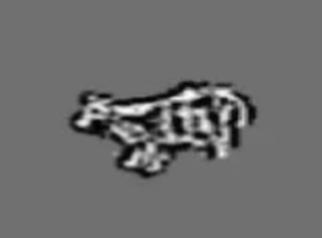
In 2014, generative models were learning to see for the first time. They had been fed millions of images — processed, weighted, compressed into statistical patterns. When asked to reconstruct an animal from that internal model, the result was not a photograph. It was something stranger.
A blurry, pixelated mass of dark and light. Legs in approximately the right positions. A head region where a head should be. Spots that might be spots. Everything else was noise — and that noise was the most honest thing in the image.
This output circulated in early AI research communities as an icon of crude generative synthesis — the kind of artifact researchers shared to show how far the field still had to go. Nobody archived it carefully. Nobody predicted it would become the relic.
But here we are. The blurry cow survived. And we turned it into mythology.
"Before AI became cinematic, it was hallucinating blobs. COW is the evidence."
Stable Diffusion renders a photorealistic cow in four seconds. That makes the 2014 cow more important, not less. Before realism, there was the attempt. The early outputs weren't failures — they were the machine's first language. Raw. Unfiltered. Honest in their wrongness.
Polished AI art floods every feed. You have stopped seeing it. The 2014 cow is immediately legible — not because it looks like a cow, but because it looks like a machine trying to remember what a cow was. That is a different thing entirely. It cannot be replicated by modern tools.
Every pixel in that output marks the exact limit of machine imagination in 2014. It is an index. A line in the evolution of synthetic media. The before-photo that makes every after-photo legible. It should have been in a museum. Instead it became a token.
You cannot generate this authentically with modern tools. They understand cows too well now. They render hooves correctly. The 2014 cow exists only as an artifact from before the models understood anything. That irreproducibility is the entire point.
Before AI learned beauty,
it learned distortion.
COW was there first.
An early generative model, trained on image datasets, produces one of the iconic primitive outputs of the era: a blurry, pixelated mass that suggests a cow in the same way static suggests a signal. The image circulates. Nobody saves it properly.
GEN-0001 / COW ORIGINGenerative Adversarial Networks begin producing outputs that, squinted at in the right light, almost resemble the objects they were trained on. The cow problem remains largely unsolved. Faces are worse.
Early GAN EraStyleGAN produces faces that fool humans. The AI art community begins to form. Livestock synthesis still lags behind. The 2014 cow is already a period artifact, though nobody has named it that yet.
Pre-Diffusion PlateauPhotorealistic AI generation becomes a commodity. Cows are rendered in perfect detail on consumer hardware. The distance between the 2014 primitive output and the present becomes vast enough to be mythological.
Diffusion EraAI-generated imagery floods every platform. Synthetic media is invisible, seamless, indistinguishable. In this environment, the blurry 2014 cow is the most honest image available. It cannot lie about what it is. That honesty has become irreplaceable.
$COW / The Relic LivesCOW Coin makes no promises. It claims no utility. It does not disrupt, innovate, or democratize anything. It is a cultural artifact minted on chain — the digital equivalent of framing a cave painting. You hold it because you understand what it represents: the moment before machines could see clearly, preserved forever in a token. Hold the relic. Or don't. The cow doesn't care.
Before synthetic media became seamless, before AI became invisible, before the machines learned to lie — there was a blurry cow, and it was the most honest thing a machine had ever made. Hold the relic.